Civils and duct
Trenching, moling and directional drilling, chambers and duct routes, with the streetworks permits and reinstatement handled by the same team.

Fibre optic cabling
Backbones inside buildings, links between them, and full network build outside. Installed by our own engineers, tested on OTDR, and handed over with a manufacturer-backed warranty.
In house, end to end
Most fibre jobs pass through three or four pairs of hands: one firm digs, another pulls, someone else splices, and a fourth tests. Every handover is a chance for the records to go missing and for a fault to become nobody's problem. We do all of it with our own people.
That covers backbones between comms rooms and floors, links between buildings across a campus or estate, and network build in the public highway. We choose single-mode or multimode by the distance and the bandwidth, not by what happens to be on the van.
What we install
Trenching, moling and directional drilling, chambers and duct routes, with the streetworks permits and reinstatement handled by the same team.
Fibre pulled, blown or floated into new and existing duct, including air-blown tube systems that take more fibre later without new civils.
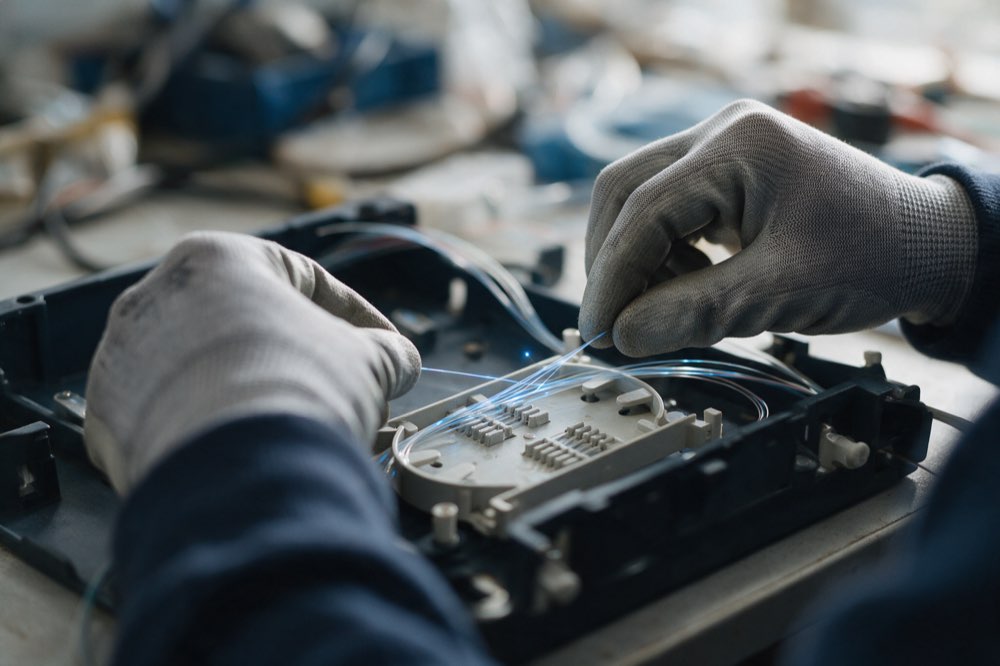
Fusion splicing in closures, cabinets and patch panels, with the loss on every joint recorded as it is made.
OTDR traces and light-loss tests on every fibre, packaged with labelling and as-built records so acceptance is a formality.
Building-to-building and site-to-site links, planned around distance, capacity and the route the cable can really take.
Faults located on the OTDR, cut and damaged cable repaired, and more capacity added to networks already in the ground.
Types of fibre
Two things decide the cable: how far the signal has to travel, and how much it has to carry. We settle that at survey, so the choice is made on paper rather than on site.
A very fine core that carries a single path of light, so the signal holds up over many kilometres. The default for links between buildings, across campuses and in network build, and the cable that leaves the most room for faster equipment later.
A wider core paired with cheaper optics, made for shorter runs inside a building: riser backbones, comms room to comms room, and data centre links where the distance is counted in metres, not kilometres.
Empty tube goes in first, and fibre is blown through it with compressed air when it is needed. Capacity can be added or moved later without opening up ceilings or ground a second time.
Fibre run all the way to the workstation, for sites where electrical interference, security or future bandwidth rule out copper even for the last few metres.
Why fibre
Copper still earns its place for the last few metres in plenty of buildings. For anything longer, busier or harder to reach, fibre is better on almost every count.
How to get started
Drawings, site addresses, rough distances and dates. A sketch on a floor plan is enough to start.
We walk the route or the building, then send a fixed price, a programme and the cable specification.
Our team installs and tests, and you get the test results, records and warranty documents at handover.
Send the scope over. We will come back with a survey date and a fixed price.